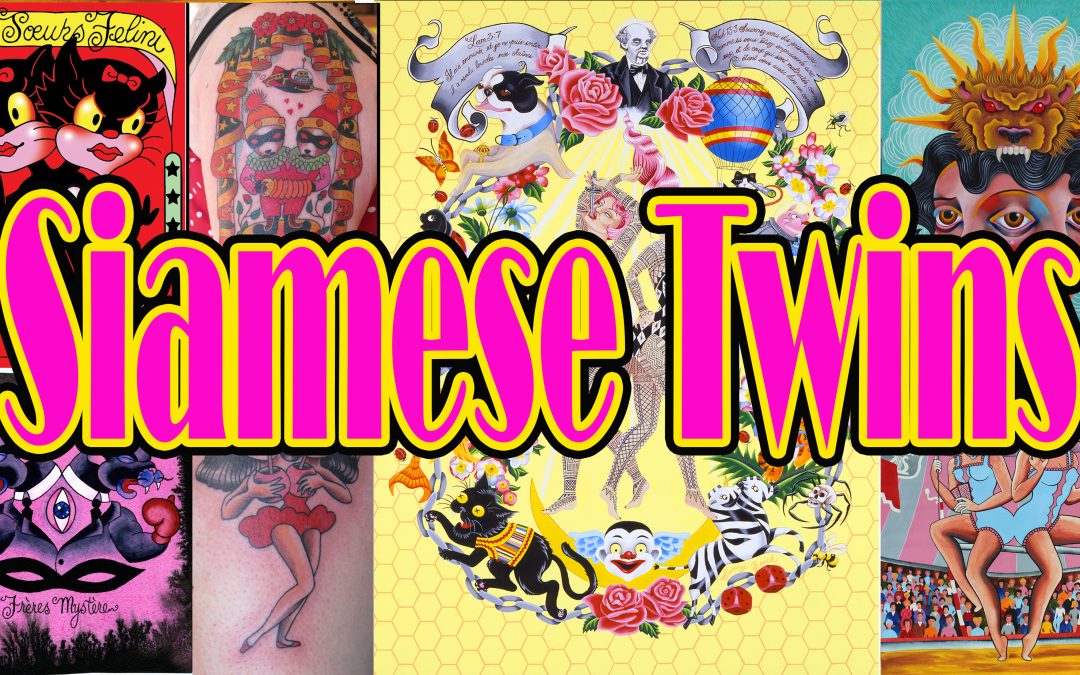
Siamese Twins
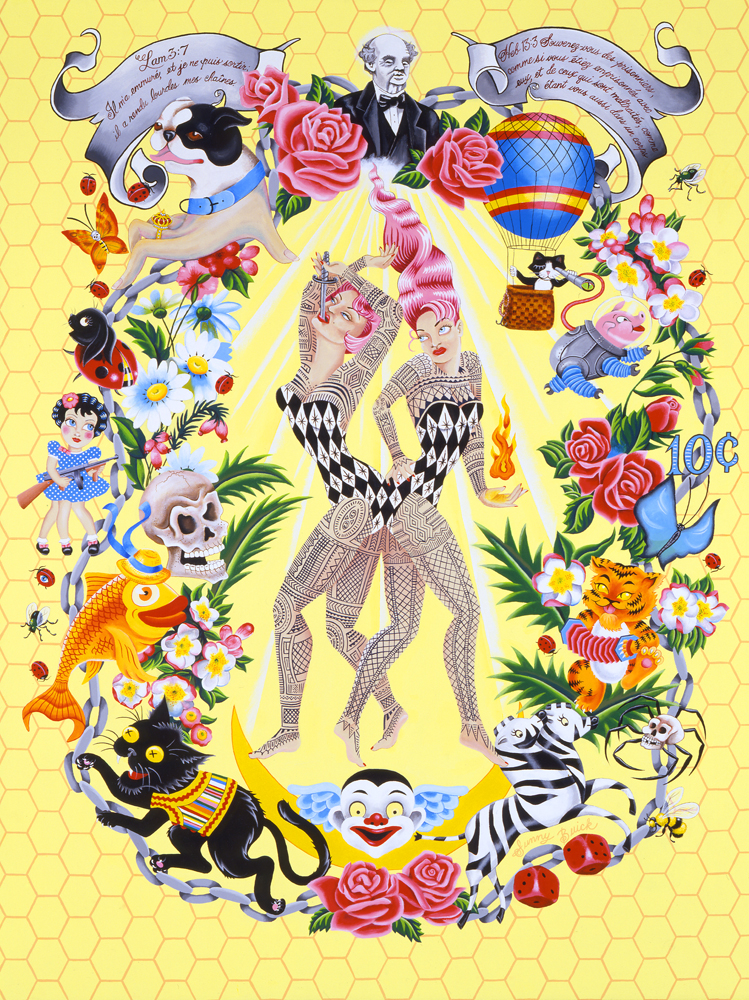
I have returned, again and again, to the image of Siamese twins in my work. Driven by my fascination with duality and attachment. These figures confront me with my own difficulties — my struggle with acceptance, my fear of abandonment, and my anxiety around permanence and impermanence.
If I try to understand this obsession, I find myself looking at my own dual nature: my shadow, my contradictions, and my fear of being left behind. In a way, I am trying to express the opposite of abandonment — a state in which separation is impossible. Because I feel that there is a fragile boundary between connection and separation, a fine line between loneliness and self-isolation. Having grown up with a sense of absence, I find myself drawn to the idea of someone who stays, no matter what.
To me, being “conjoined” carries a powerful emotional meaning: it is to feel both deeply connected and quietly trapped. I feel compassion for two people bound together against their will, in contrast to the instability I experienced. It makes me wonder about the complexity of relationships: Do they argue? Do they long for privacy? Do they wish to escape? Or do they feel complete in a way others cannot?
At the same time, I am drawn to the idea of the double. I want to look in the mirror and see someone else looking back. To be myself and another at once. To have a counterpart — a lost twin, a version 2.0, a reflection that reveals what I cannot see alone. Mirroring allows for empathy: we recognize ourselves in others, especially in the parts we suppress. Often, I learn the most about myself through friction — through the reverse side of who I think I am. I am also drawn to the unsettling. There is a tension between attraction and repulsion, between fascination and discomfort. This push and pull feels essential — not just in my work, but in existence itself.
Ultimately, these figures become metaphors for my emotional landscape — shaped by a fear of impermanence and a desire for stability. I am learning, slowly, to accept that nothing remains fixed, that everything is in constant evolution.
Perhaps this is why duality matters so much to me. It offers a way to hold contradictions at once. Two perspectives, side by side, in dialogue rather than opposition. Not a battle, but an attempt to arrive at a shared truth.
In this sense, doubleness is not just conflict — it is also unity.
A fragile, complicated, inseparable whole
Fractured Self
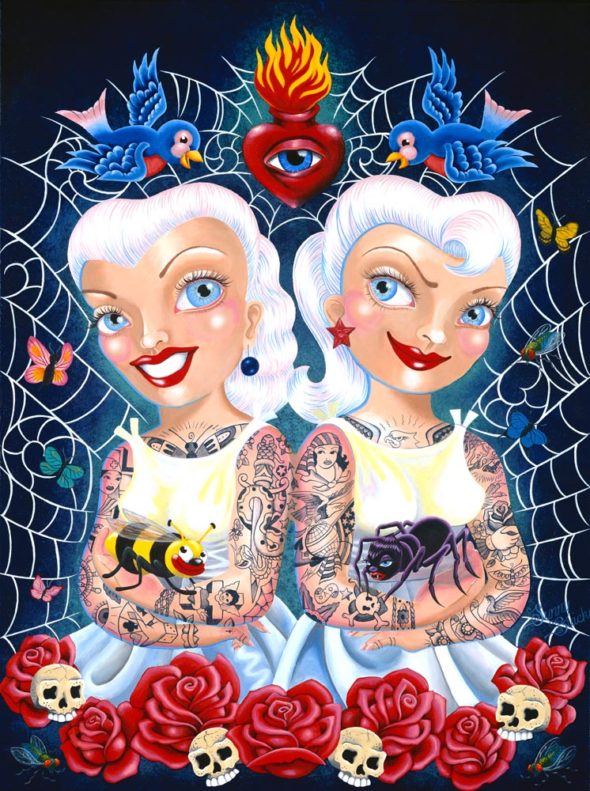
There are parts of me that feel deeply in conflict, yet inseparable. This inner tension makes the image of conjoined twins feel familiar, almost autobiographical. They can be seen as two sides of one person — fragmented, multifaceted, sometimes harmonious, sometimes at odds. I think of emotional states that split and collide, of identities that shift and overlap. My inner world feels faceted, like a diamond or a coin with opposing sides.
I see identity as a composite — a multiplicity of selves coexisting within one body. The image of Siamese twins becomes a powerful symbol of this fractured self: two beings who are distinct, even oppositional, yet inseparable. They mirror the paradox of identity — constantly shifting, never fully knowable, even to ourselves. If another self lives within me, can I ever truly understand her?
What interests me is the connection we try to deny. So often, we place others in hierarchies, convincing ourselves we are separate, independent, self-sufficient. And yet our humanity binds us. The illusion of separation is what fuels isolation, conflict, even violence. If we are, in some sense, bound together, then the question becomes: how do we learn to coexist? Because emotionally, socially, spiritually — learning to coexist is essential.
Internal Struggles
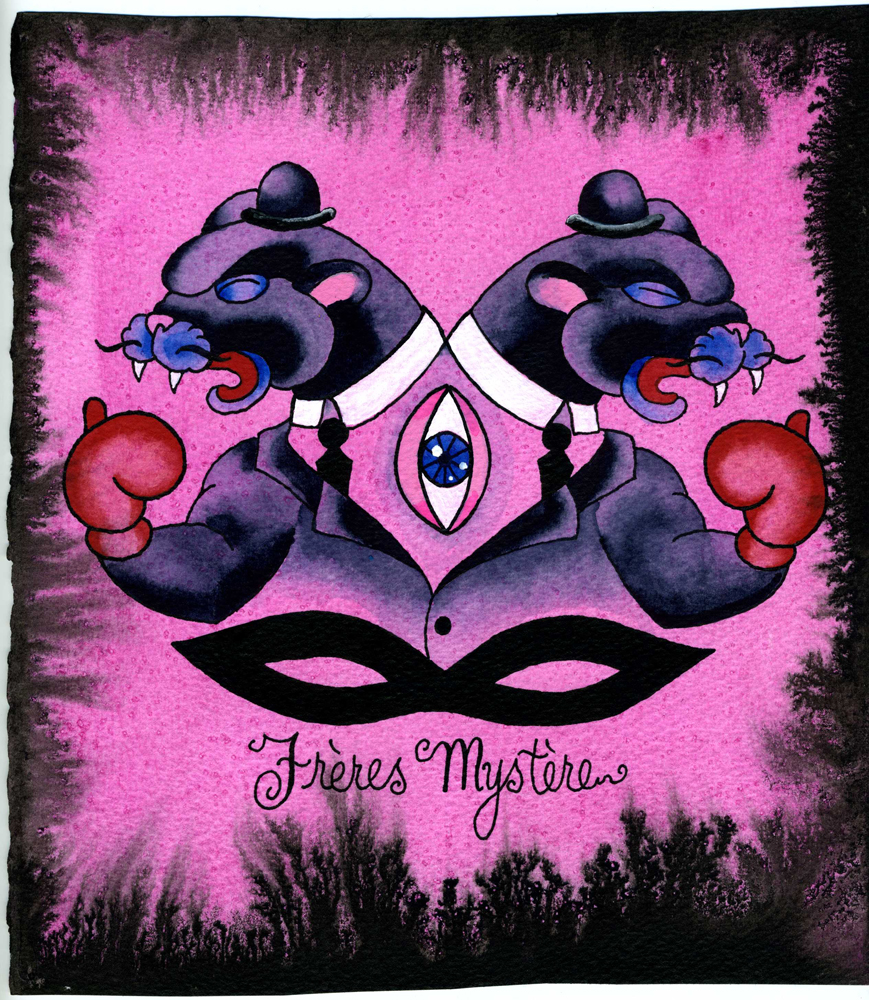
Around the age of 27, I painted a figure suspended between two identities: a red-skinned devil girl standing on a stage, framed by purple curtains, holding a mirror. From the outside, she appears sensual and transgressive — but in the mirror, she sees herself as an angel.
That painting was a turning point. It expressed how I saw myself, but also how I believed others perceived me. It revealed a distortion — a warped perception shaped by misunderstanding, projection, and doubt. It revealed a deep conflict between who I am and who I fear I am. Looking back, I wonder how much of that conflict was real, and how much was an illusion I had constructed.
At the time, I felt caught between opposing desires: an internal conflict between wanting to belong and to withdraw, needing to be accepted and to remain apart. There was regret, and a deep sense of isolation — the feeling of being different, of not conforming, of not being fully seen or supported.
Over time, this internal tension evolved in my work into more explicit imagery: fighting girls, violence, death, and the interplay between darkness and light. The conflict between the heart and the mind became externalised, embodied.
Through the figure of the conjoined twin, I explore inner conflict as a state of inescapability — no privacy, no distance, no silence. This reflects my experience of the inner voice: persistent, unavoidable, sometimes overwhelming. To feel divided, powerless, and yet unable to detach. The challenge then becomes whether I can accept this condition, admit a lack of control, and find a way to reconcile these opposing forces.
I often think about what it means to have someone for life. In reality, there are no guarantees — not in friendship, family, or love. Even the bonds we believe to be permanent can dissolve. This makes me reflect on the fragile balance between our need for connection and the darker side of dependence.
When I see images of conjoined twins, I feel something deeply familiar. For me, they embody my conflicting desires: independence and attachment, solitude and companionship, freedom and permanence. Two sisters fused together begin to resemble a solution to loneliness — a fantasy of never being abandoned, never being alone.
In French, solitaire and solidaire are nearly identical, yet their meanings diverge: to be alone, or to be supported. In English, “lonely” and “supported” feel worlds apart. And yet the distance between them is fragile. Perhaps the idea of “two in one” suggests a bridge — a way of being both autonomous and connected.
The Monsterous and the Marginal
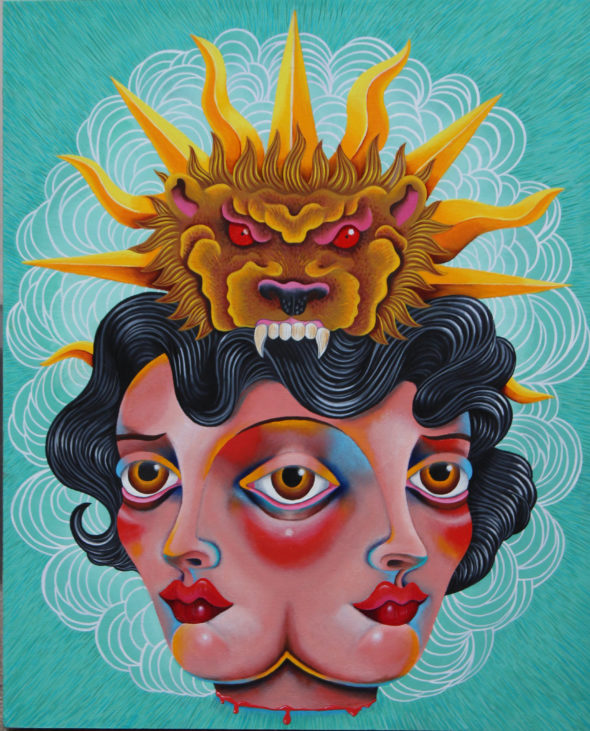
I have long been drawn to what is considered monstrous or “other.” These terms — like “freak” or even “Siamese twin” — are now contested, yet they still hold meaning in my work. I am interested in reclaiming the monstrous, not as something to reject, but as something that reveals how difference is constructed. Historically, even femininity has been framed as deviation or failure — a “monstrosity” within a rigid system of norms. To embrace the monstrous, then, is to resist those structures and to allow transformation.
Mutation, to me, is not failure but evolution — a rebellion of nature, a site of change and possibility. My work imagines hybrid, unstable forms that blur boundaries: between self and other, human and animal, unity and fragmentation. These figures are not fixed; they are in a state of becoming.
This fascination is also personal. My grandmother was born without arms and adapted to the world in her own way. Her difference, her resilience, left a ancestral mark on me. As my interest in tattooing and body transformation grew, so did my curiosity about other bodies that exist outside the norm. Historically, these bodies were displayed, exploited, turned into spectacle — particularly in circus sideshows, which also fascinate me. The circus, for me, represents a heightened version of life: chaotic, dramatic, precarious.
Among all forms of difference, twins — and especially conjoined twins — remain the most compelling to me. The idea that one body can become two, that two can remain one, that a mirror image can exist with an entirely separate mind — continues to intrigue me.
Psychologically, this reflects a lifelong feeling of being “different,” of not fully belonging. Creatively, it allows me to bring together disjointed elements — to merge contradictions into something new. My work explores dependence and interdependence, questioning whether connection is a form of support or a kind of prison. The body and mind, like the twins, cannot be separated; reason and imagination must find balance.
Becoming
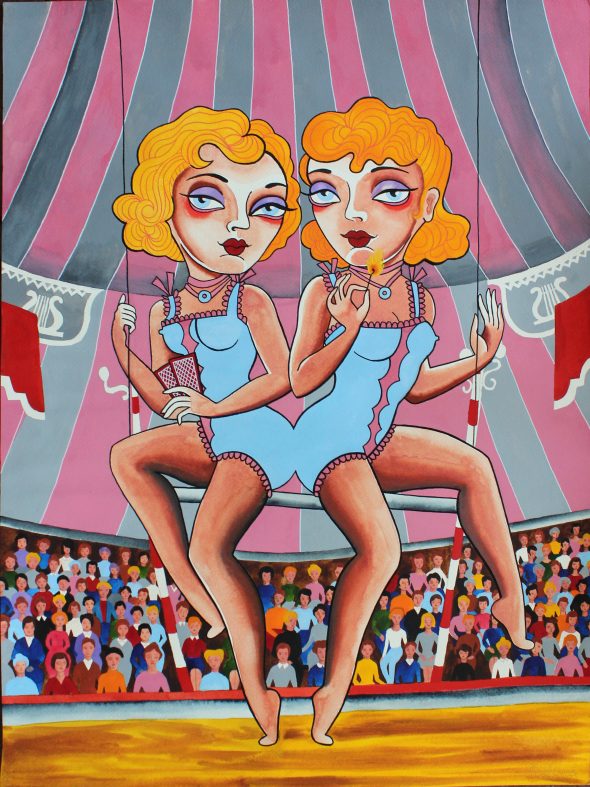
Ultimately, my work is about becoming. About transformation, contradiction, and the attempt to reconcile opposing forces.
I explore connection as both support and constraint — a bond that can feel like a lifeline or a prison. The body and mind, like the twins, cannot be separated. Reason and imagination must coexist.
Through painting — and increasingly through sculpture, digital media, and other forms — I try to give shape to this complexity.
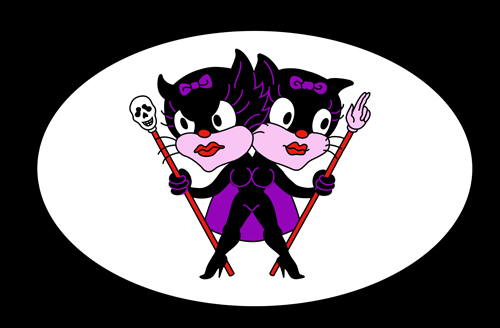
Repetition, Symmetry, and the Search for Balance
My process is shaped by repetition. I return to the same symbols — twins, mirrors, doubles — because I feel there is always more to say. Often, it is only through repetition that meaning becomes clearer.
I began to recognize these patterns in my work when others pointed them out to me. What I thought were isolated images revealed themselves as part of a larger, ongoing investigation.
Symmetry plays a central role in this exploration. Through the twin motif, I search for balance — a way to hold opposing forces in equilibrium. Symmetry suggests stability, clarity, even sanity: the ability to see both sides, to remain centered, to walk the tightrope without falling.
And yet, this balance is never fixed. It shifts constantly, like a seesaw moving between extremes — emotion and reason, connection and isolation, control and chaos.
Perhaps this is why I believe that reconciling opposites is essential. Not eliminating conflict, but learning to hold it. To accept contradiction as a condition of being.
When I paint conjoined figures, I create both bodies simultaneously. They emerge together, as one form. This is important — they are not separate entities brought together, but a single existence expressed in two parts. The technique mirrors the meaning.
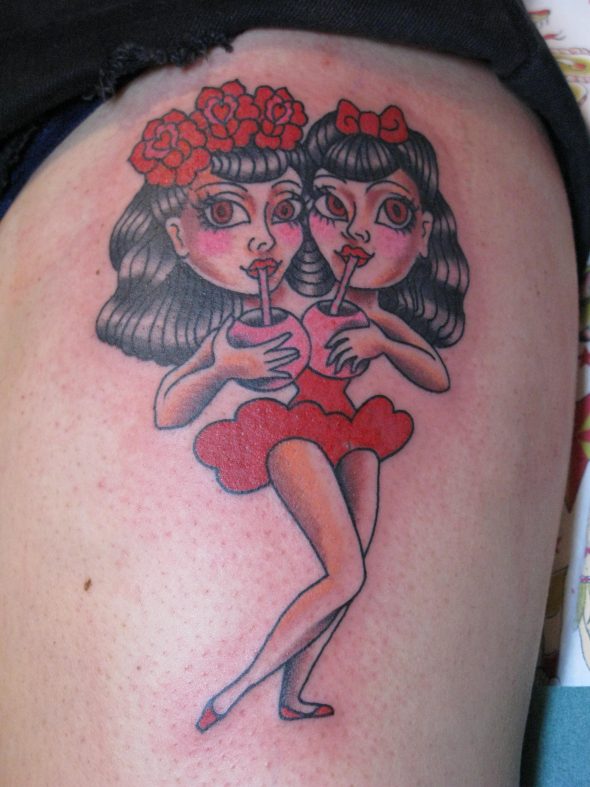
Inviting the Viewer Into the Tension
I am interested in that space where attraction and repulsion coexist — There is always tension: fascination and fear. I am drawn to what unsettles me. These forces — like duality itself — feel fundamental to existence.
I want my work to provoke recognition. I want my work to provoke both emotion and questioning.
To invite viewers to confront their own contradictions. I want them to feel curious, to look longer, to search for meaning. To recognize something of themselves in the image, even if they cannot immediately explain it.
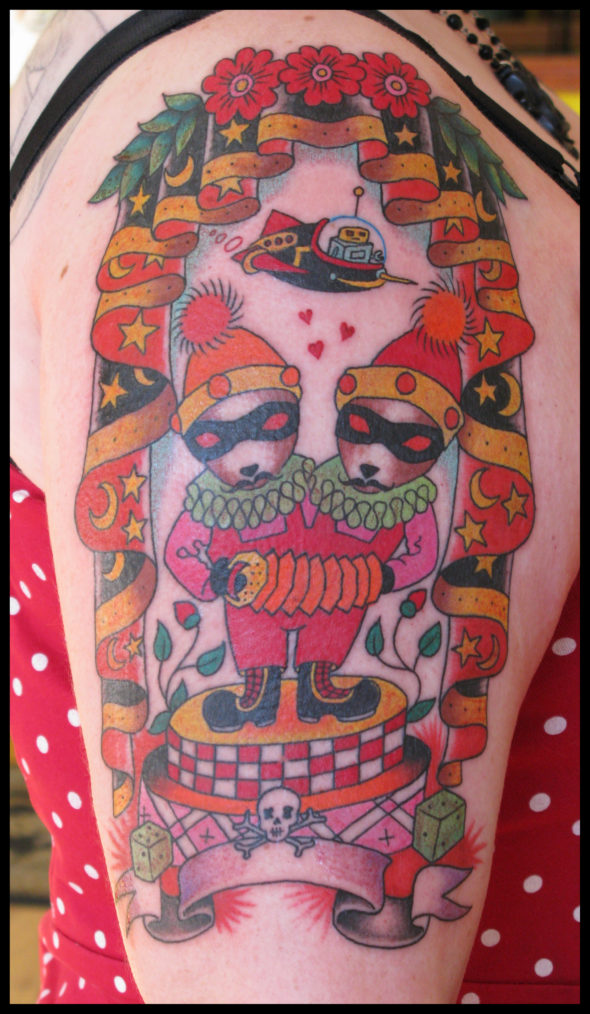
Origins and Influences
This theme first appeared in my work when I was invited to participate in a circus-themed exhibition in Detroit, and it has continued to evolve — influenced in part by tattoo clients who are drawn to similar imagery. I often feel most compelled to return to it during emotionally intense periods or moments of transition.
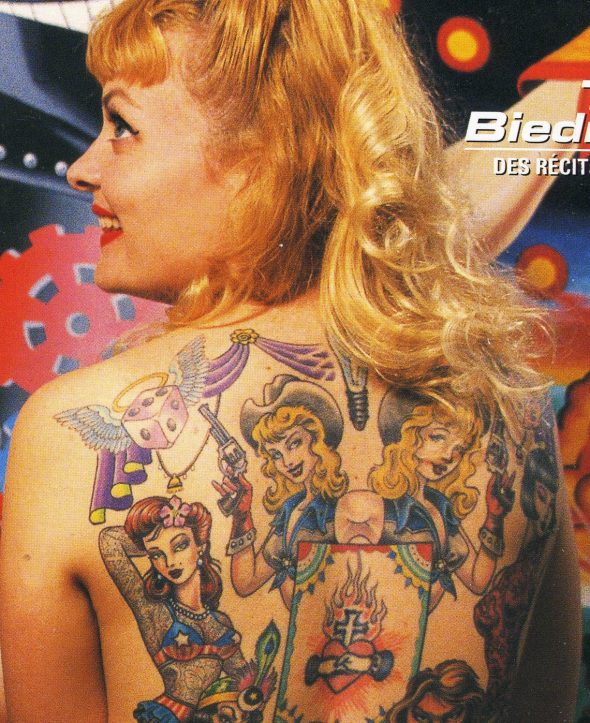
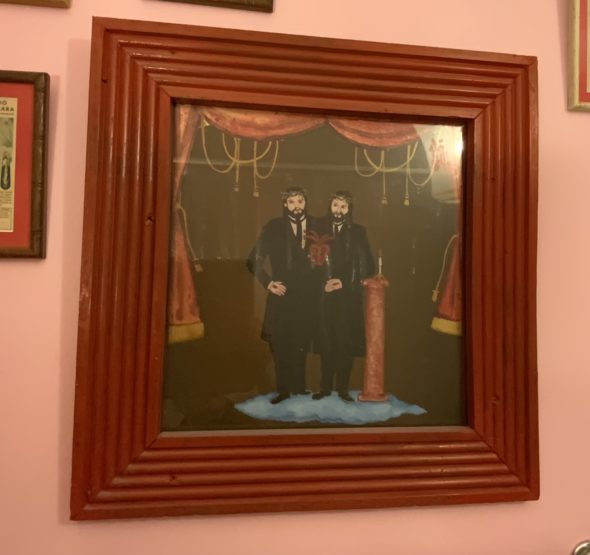
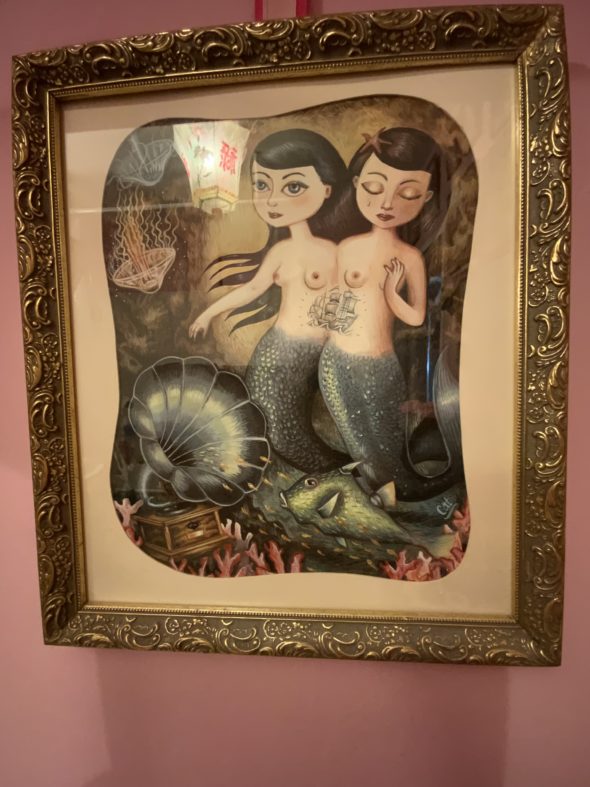
The imagery is also personal. I carry a tattoo on my back of Siamese twin cowgirls — part of a larger sideshow tableau. And I collect images of twins created by other artists: twin mermaids, conjoined Jesuses. These references form a visual language that continues to expand.
Historical figures such as Chang and Eng Bunker, or Daisy and Violet Hilton, also inform my thinking. Their lives — lived both together and as individuals — reflect the same tensions I explore: connection, dependence, identity, and separation.
I am also influenced by art and culture that explore duality and doubling — from paintings like The Two Fridas to films such as The City of Lost Children, with its strange, hybrid characters, like the ‘Octopus’. Mythology offers further echoes: Castor and Pollux, Romulus and Remus, yin and yang — all expressions of a divided yet inseparable whole.
Audience, Recognition, and Shared Meaning
When I began asking viewers how they respond to my work, I discovered that many of them recognized exactly what I was trying to express.
Some are drawn in despite — or because of — a sense of discomfort. Others see the twins as a metaphor for internal conflict: good and evil, balance and imbalance, connection and separation, competing voices within the self.
Many viewers immediately perceive the twins as symbolic rather than literal.
People recognize their own internal plurality in the imagery. They see themselves. They recognise a feeling of being “different,” “weird,” or on the margins of society. One viewer told me the paintings were “weird and wonderful,” and that they felt the same way about me — that the works resembled my own dual nature. The images give permission to embrace the odd, the uncanny, the unclassifiable.
They find beauty in the strange, pleasure in the bizarre. Others are captivated by the colors and details, imagining stories unfolding within the images.
Recurring themes in their responses include longing, attachment, and the search for a missing half — a soulmate, a counterpart. Some even describe the twins as representing two sides of one person, or suggest that my work functions as a kind of self-portrait.
What moves me most is this sense of recognition — that something deeply personal can also be widely understood.
Conclusion
Through painting, and increasingly through sculpture, digital media, and potentially performance, I try to give form to these ideas. So far, painting has been the most effective medium for capturing this complexity, but I am interested in expanding into other forms that physically embody connection and fragmentation.
Ultimately, I want my work to provoke recognition. I want viewers to see the monstrous not as something external, but as something within us all. To feel both disturbed and seduced. To recognize their own contradictions, their own multiplicity.
Because the more I understand myself, the more I realise how complex, unstable, and unfinished I am — always changing, always searching.
Searching for connection.
For meaning.
For the missing part.
When you look at my images of Siamese twins, do you imagine separation — or do you see their unity as something eternal?
My obsession clearly points to something unresolved within me, something that seeks healing. And yet, I also wonder if I am trying to preserve the contradiction — to keep both sides alive, in tension, forever.
A Small Honor: Two Cover Variants
A Symbolic Moment
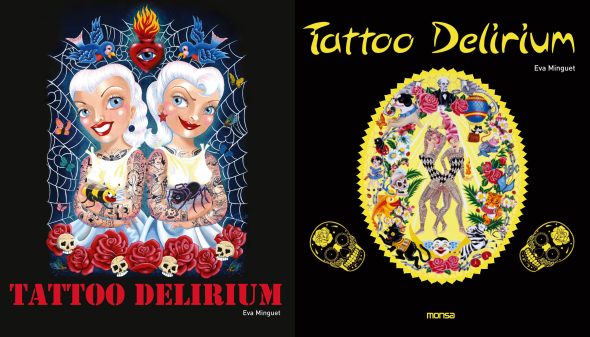
Once, two of my Siamese twin paintings were selected for an anthology book cover. The editors couldn’t choose between them, so the book was published with two alternate covers — an echo of the very theme that runs through my work. That small coincidence felt like a perfect affirmation of the path I’m on.